
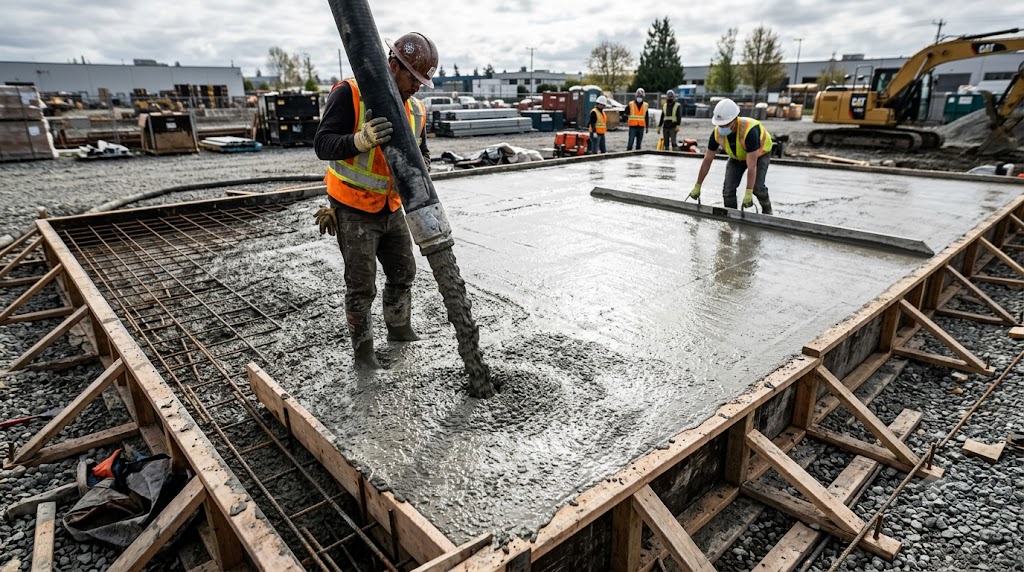
Whether you’re pouring a patio, a driveway, or a small footing, getting your concrete order right the first time saves you money and saves you a second trip to the supply yard. Knowing how to calculate concrete by hand takes just three measurements and one simple formula — no special tools required.
In this guide, you’ll learn the exact formula concrete professionals use, walk through a real example, and see how to convert your result into the units your supplier actually needs.
The Basic Concrete Formula
Concrete is sold by volume, and volume is always the same three-step calculation no matter the shape of your project:
Length × Width × Depth = Volume
Measure all three dimensions in the same unit (feet is easiest in the US), multiply them together, and you have the volume in cubic feet. From there, a couple of quick conversions get you to the number your ready-mix supplier will actually ask for: cubic yards.
Step-by-Step: How to Calculate Concrete Yards
Here’s exactly how to calculate concrete yards for a standard slab, footing, or wall.
Step 1: Measure Length and Width
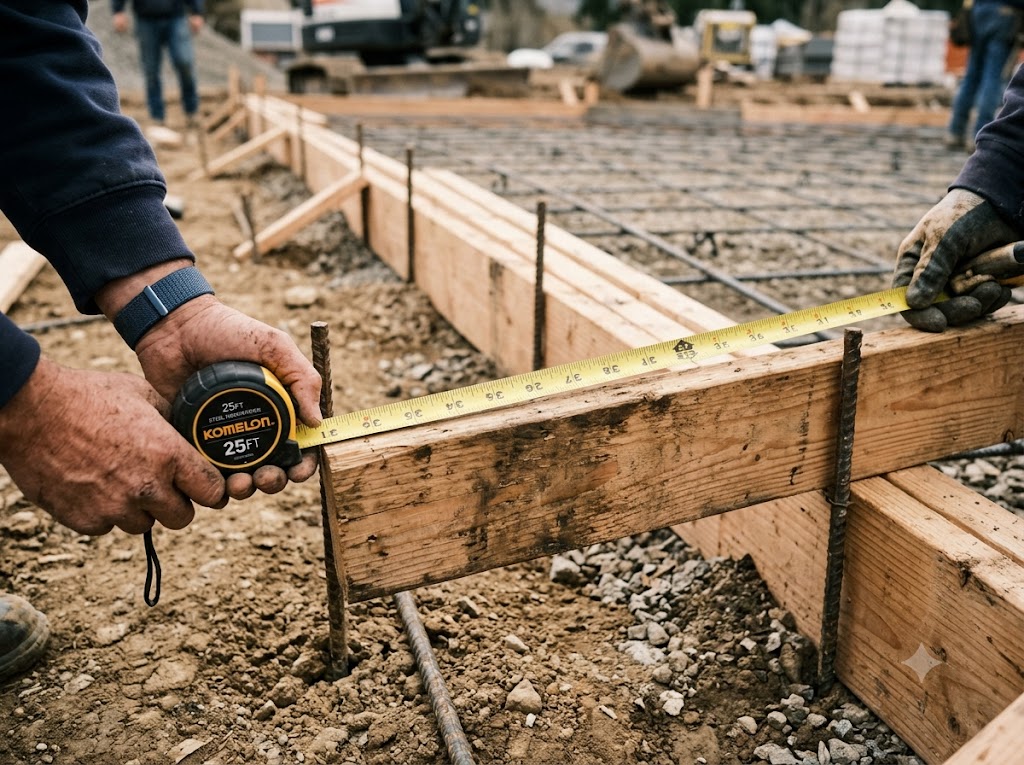
Measure the length and width of the area in feet. For irregular shapes, break the area into rectangles, calculate each separately, and add the results together at the end.
Step 2: Measure Depth (Thickness)
Depth is usually the smallest number and the easiest one to get wrong. Standard slab thickness is often 4 inches, which is 0.33 feet (divide inches by 12 to convert to feet).
Step 3: Multiply to Get Cubic Feet
Volume (ft³) = Length (ft) × Width (ft) × Depth (ft)
Step 4: Convert Cubic Feet to Cubic Yards
Ready-mix concrete is ordered by the cubic yard, and there are 27 cubic feet in one cubic yard:
Cubic Yards = Cubic Feet ÷ 27
Worked Example
Let’s say you’re pouring a 10 ft × 10 ft patio slab, 4 inches thick.
- Convert depth to feet: 4 in ÷ 12 = 0.33 ft
- Calculate volume: 10 × 10 × 0.33 = 33 cubic feet
- Convert to yards: 33 ÷ 27 = 1.22 cubic yards
So this patio needs about 1.22 cubic yards of concrete. Most suppliers will round this up to 1.25 or 1.5 yards to account for spillage, uneven subgrade, and minor measurement error — always order slightly more than your exact estimate.
How to Calculate Concrete Yardage for Bags Instead
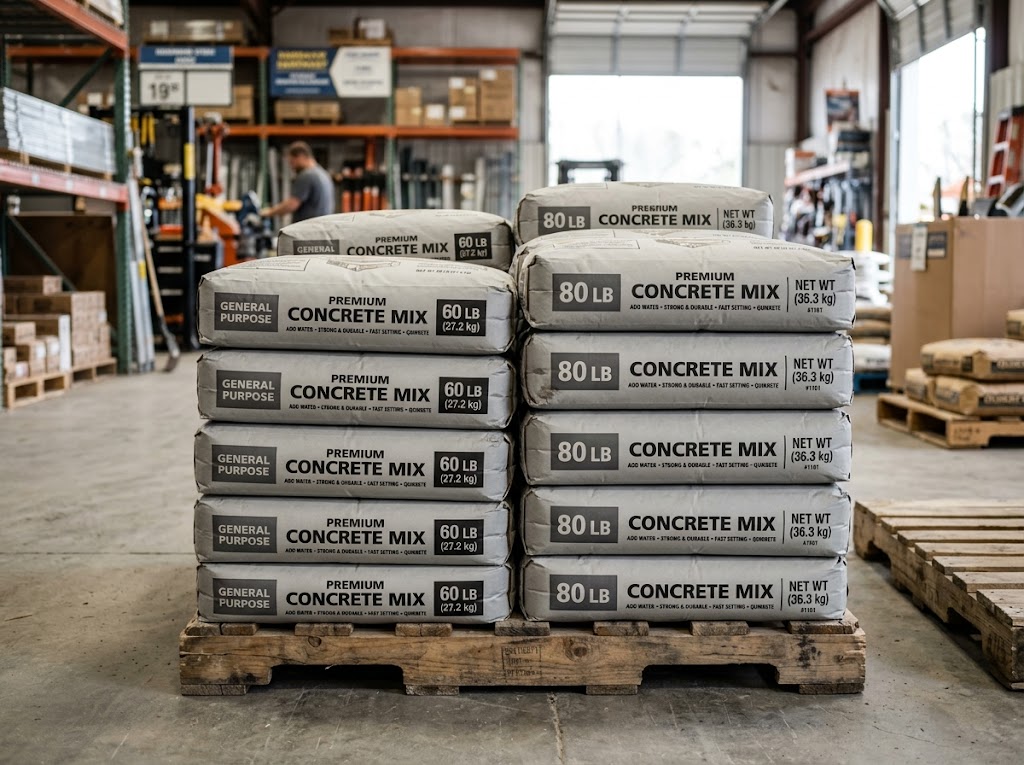
If you’re mixing your own concrete from bags rather than ordering ready-mix, convert your cubic feet total into bags:
- One 60 lb bag yields about 0.45 cubic feet of concrete
- One 80 lb bag yields about 0.60 cubic feet of concrete
Using the same 33 cubic foot example:
33 ÷ 0.45 ≈ 74 bags (60 lb)
33 ÷ 0.60 ≈ 55 bags (80 lb)
Skip the Math — Use Our Free Concrete Calculator
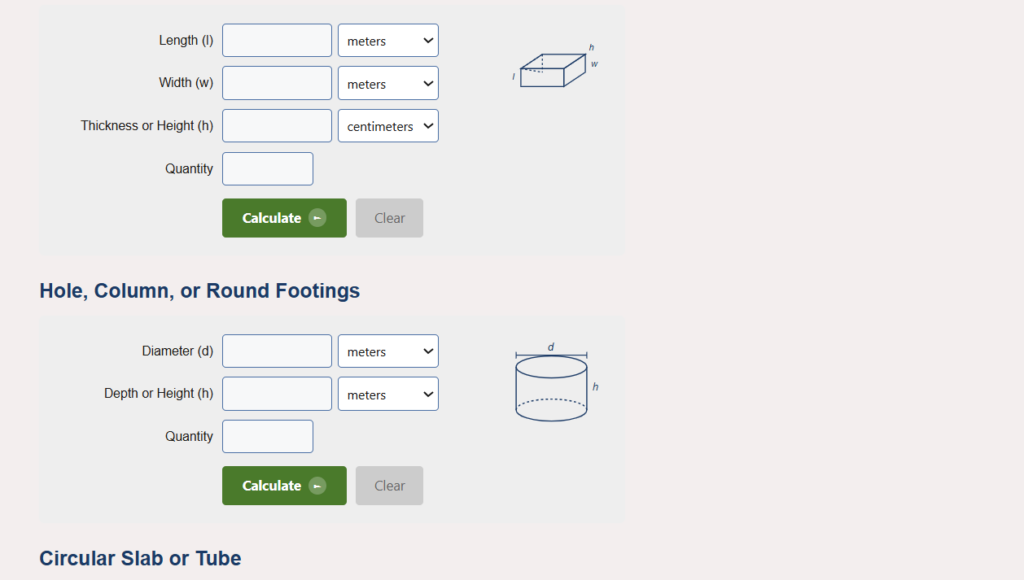
If you’d rather not do the conversions by hand, our Concrete Calculator does all of this instantly. Just enter your length, width, and depth in whatever units you have feet, inches, or meters and get your result in cubic yards, cubic meters, and bags, all at once. It also handles round columns, circular slabs, curbs and gutters, and stairs, so you don’t need to redo this formula by hand for every shape.
Frequently Asked Questions
How do I calculate yards of concrete for an odd-shaped area?
Split the area into simple rectangles or triangles, calculate the volume of each piece separately using length × width × depth, then add all the volumes together before converting to cubic yards.
How do you calculate concrete yardage for a round footing?
For circular shapes, use radius squared × π × depth instead of length × width. Our calculator handles this automatically if you’d rather skip the manual math.
How do I calculate concrete yards if my dimensions are in inches?
Convert every measurement to feet first (divide inches by 12), then apply the standard formula: length × width × depth ÷ 27.
Why should I order more concrete than I calculated?
Ground is rarely perfectly level, some concrete is lost to spillage during the pour, and forms can shift slightly. A 5–10% buffer above your calculated volume helps you avoid running short mid-pour, which can weaken the finished slab.
What’s the difference between cubic feet and cubic yards?
A cubic yard is simply 27 cubic feet (3 ft × 3 ft × 3 ft). Concrete calculations naturally produce cubic feet first, so dividing by 27 converts that number into the unit ready-mix trucks are ordered in.