
What Is a Scientific Calculator?
A scientific calculator is an advanced electronic calculator designed to perform mathematical operations beyond basic arithmetic. Unlike a standard calculator, it can solve complex equations involving trigonometry, logarithms, exponents, roots, fractions, scientific notation, and statistical functions.
Students, teachers, engineers, scientists, accountants, and researchers rely on scientific calculators every day because they provide accurate results for advanced calculations. Today, you can choose between a physical device or an online scientific calculator, making powerful mathematical tools accessible from any computer or smartphone.
If you’re wondering what is a scientific calculator, this guide explains everything you need to know, including its features, functions, uses, and how it differs from other types of calculators.
How Does a Scientific Calculator Work?
A scientific calculator processes mathematical expressions using built-in algorithms. Instead of performing only addition, subtraction, multiplication, and division, it can evaluate complex formulas with multiple operations.
Most scientific calculators include dedicated buttons for:
- Trigonometric functions
- Logarithmic calculations
- Exponents and powers
- Square roots and cube roots
- Fractions
- Scientific notation
- Constants such as π and e
- Parentheses for complex equations
Modern scientific calculators also follow the correct order of operations automatically, reducing calculation errors.
Main Functions of a Scientific Calculator
One reason millions of people use a scientific calculator is its wide range of mathematical functions.
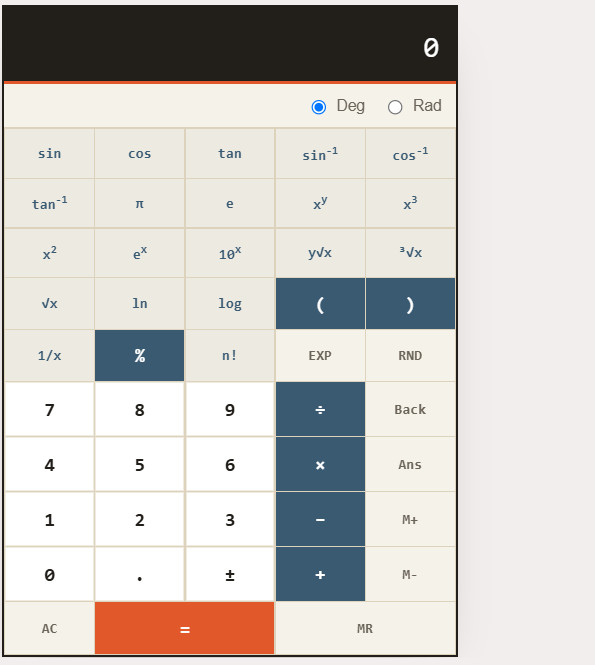
Basic Arithmetic
Every scientific calculator supports:
- Addition
- Subtraction
- Multiplication
- Division
- Percentages
Although these are basic operations, they remain essential for everyday calculations.
Trigonometric Functions
Scientific calculators include:
- sin
- cos
- tan
They also provide inverse functions:
- sin⁻¹
- cos⁻¹
- tan⁻¹
These functions are commonly used in geometry, physics, engineering, and navigation.
Logarithms
Most scientific calculators include two logarithm functions:
- log
- ln
These are essential for solving exponential equations, chemistry problems, finance calculations, and higher mathematics.
Exponents and Powers
Scientific calculators can calculate:
- x²
- x³
- xʸ
This makes them useful for algebra, geometry, engineering, and scientific research.
Roots
Instead of estimating roots manually, users can calculate:
- Square roots
- Cube roots
- Higher-order roots
The calculator provides accurate answers instantly.
Fractions
Many scientific calculators support fraction calculations.
You can:
- Add fractions
- Subtract fractions
- Multiply fractions
- Divide fractions
- Convert fractions to decimals
This feature is especially helpful for students.
Scientific Notation
Scientific notation allows users to express very large or very small numbers efficiently.
For example:
4,500,000
becomes
4.5 × 10⁶
Likewise,
0.000032
becomes
3.2 × 10⁻⁵
Scientists and engineers frequently use this feature because it simplifies complex calculations.
Who Uses a Scientific Calculator?
Scientific calculators are valuable in many professions and educational fields.
They are commonly used by:
- Students
- Mathematics teachers
- Engineers
- Architects
- Scientists
- Chemists
- Physicists
- Statisticians
- Surveyors
- Financial analysts
Anyone working with advanced mathematics benefits from using a scientific calculator.
Scientific Calculator vs Basic Calculator
Although both devices perform calculations, their capabilities differ significantly.
| Feature | Basic Calculator | Scientific Calculator |
|---|---|---|
| Addition & Subtraction | ✅ | ✅ |
| Multiplication & Division | ✅ | ✅ |
| Fractions | ❌ | ✅ |
| Trigonometry | ❌ | ✅ |
| Logarithms | ❌ | ✅ |
| Exponents | ❌ | ✅ |
| Scientific Notation | ❌ | ✅ |
| Advanced Equations | ❌ | ✅ |
For simple shopping or budgeting, a basic calculator is sufficient. However, academic and technical work requires a scientific calculator.
Scientific Calculator vs Graphing Calculator
Many beginners ask whether a graphing calculator is the same as a scientific calculator.
A scientific calculator focuses on advanced mathematical functions, while a graphing calculator can also plot graphs, visualize equations, analyze functions, and store programs.
For example, the popular TI-84 is a graphing calculator that includes all scientific calculator functions plus advanced graphing capabilities.
Benefits of Using a Scientific Calculator
Using a scientific calculator offers several advantages.
These include:
- Faster calculations
- Greater accuracy
- Support for advanced mathematics
- Easy scientific notation
- Built-in constants
- Fraction calculations
- Trigonometric functions
- Logarithms
- Powers and roots
- Reduced human error
Because of these features, scientific calculators save time and improve productivity.
Can You Use an Online Scientific Calculator?
Yes.
Today, millions of users prefer an online scientific calculator because it works directly in a web browser.
An online calculator offers several benefits:
- No installation required
- Free access
- Works on phones and computers
- Fast calculations
- Easy to use
- Available anytime
For everyday calculations, an online scientific calculator provides the same essential functions as many physical devices.
Popular Scientific Calculator Brands
Several manufacturers produce reliable scientific calculators.
Some of the most popular include:
- Casio
- Texas Instruments (TI)
- Sharp
- Canon
- HP
Among these, Casio and Texas Instruments remain the most popular choices for students and professionals.
Tips for Choosing the Best Scientific Calculator
Before purchasing a scientific calculator, consider the following:
- Available mathematical functions
- Display quality
- Fraction support
- Scientific notation support
- Memory functions
- Battery life
- Exam approval
- Ease of use
Choosing the right calculator depends on your academic or professional needs.
Frequently Asked Questions
What is a scientific calculator?
A scientific calculator is an advanced calculator capable of solving mathematical equations involving trigonometry, logarithms, exponents, fractions, roots, and scientific notation.
What is the difference between a scientific calculator and a normal calculator?
A scientific calculator includes advanced mathematical functions, while a normal calculator performs only basic arithmetic operations.
Can I use a scientific calculator online?
Yes. Many websites provide free online scientific calculators that work on computers, tablets, and smartphones.
Is a scientific calculator necessary for students?
Yes. Students studying algebra, geometry, calculus, chemistry, physics, or engineering often need a scientific calculator.
Can a scientific calculator solve scientific notation?
Yes. Nearly every scientific calculator includes an EXP or EE function for working with scientific notation.
Conclusion
A scientific calculator is much more than a basic calculator. It is an essential tool for solving advanced mathematical and scientific problems quickly and accurately. Whether you are a student preparing for exams, an engineer working on technical projects, or a professional performing complex calculations, understanding what a scientific calculator is helps you make better use of its powerful features.
From trigonometric functions and logarithms to fractions, exponents, and scientific notation, a scientific calculator simplifies calculations that would otherwise take much longer to complete. Whether you choose a physical device or an online scientific calculator, mastering its functions will improve both speed and accuracy in everyday mathematical tasks.